Inverse Methods Project
Thermal diffusivity estimation from Flash thermograms
MATLAB
Thermal diffusivity estimation from Flash thermograms
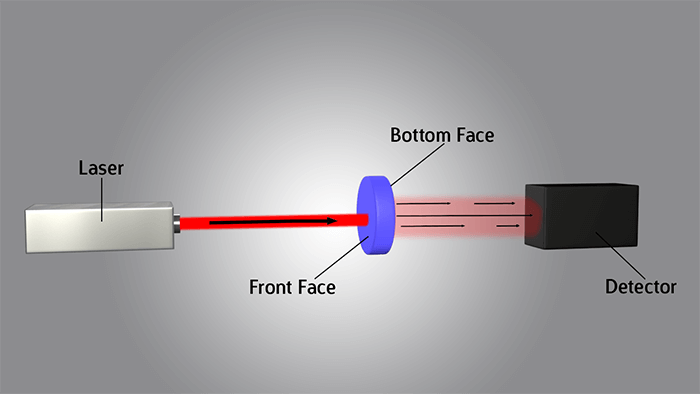
Conducted within an ENSAM “Inverse Methods” project, this work focused on estimating key thermal parameters (mainly thermal diffusivity) from Flash/LFA thermograms. The objective was to compare analytical estimation techniques with inverse and probabilistic methods, and to evaluate their robustness to measurement noise for both single-layer (monolayer) and two-layer (bilayer) thin-film cases.
Starting from the physics of 1D heat conduction (Parker / Carslaw & Jaeger background) and practical non-idealities (losses and finite pulse duration), the project implemented a full workflow: initial parameter guessing, signal smoothing, nonlinear least-squares identification (Gauss–Newton), and a Bayesian approach using MCMC (Metropolis–Hastings) to quantify uncertainty and parameter correlations.
This project strengthened my skills in heat-transfer modeling, parameter identification, and uncertainty analysis. It provided a complete, engineering-oriented view of inverse problems: from physics-based modeling to robust estimation under noisy experimental conditions, and from deterministic optimization to probabilistic inference.
View Full Report (PDF)